
Technical Reports: AI Critique
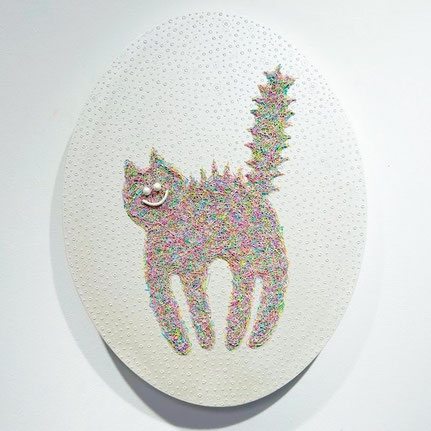
File 17: Mixed Emotions/Cats/Whity pearl and Colorful, MEG, 2026
注:初版に引き続いて改訂版が追加されています。
1. 詳細版批評
記述
MEGのこの作品は、白い楕円形の支持体の上に、絞り出された絵の具の糸状の集積によって猫の姿を浮かび上がらせている。画面は一見すると明るく愛らしいが、その愛らしさは平滑な描写によってではなく、複雑に絡まり合う線の密度によって成立している。猫の輪郭は単純で、耳、胴体、四本の脚、まっすぐ立ち上がる尾が明快に読める一方、その内部はピンク、黄、緑、青、白などの細い絵の具の線が乱雑に交差し、毛並みというよりも神経網、繊維、あるいは祝祭的なノイズのように見える。顔の部分だけは白い球状の目と弧を描く口によって、素材の混沌から抜け出すように記号化されている。背景には小さな点状・花状の凹凸が反復され、猫の多彩な線のざわめきに対して、静かな白のリズムを与えている。
文脈づけ
技法として提示されている「小さな絞り袋に絵の具を入れ、絵の具を絞り出して糸が絡み合ったように描く」という方法は、この作品を単なる猫の絵ではなく、描く行為そのものを可視化する作品にしている。筆で面を塗るのではなく、絵の具を押し出し、線状の物質として積み上げることで、イメージは描写というより生成される。ここでは作者の手の動き、圧力、速度、偶然の絡まりがそのまま画面に残るため、猫は完成された図像であると同時に、制作過程の堆積物でもある。現代的なハンドメイド感、クラフト的親密さ、装飾的楽しさが強いが、それは軽さに留まらず、絵の具という物質が自ら形を作っていく感覚を伴っている。
分類
この作品は、絵画、レリーフ、クラフト、装飾美術の境界に位置している。平面上に描かれているが、絞り出された絵の具は明確な厚みを持ち、視覚だけでなく触覚的な鑑賞を誘う。猫の単純化されたフォルムと笑顔はポップ・アートやイラストレーションに近く、糸状の線の集積は抽象表現的なオールオーバーの筆致にも接近する。ただし、抽象表現主義のように劇的な内面の噴出を前面化するのではなく、親しみやすい動物の形の中に制御された混沌を閉じ込める点に特徴がある。分類上は、ポップな動物表象と物質的レリーフ絵画が交差する、装飾的かつプロセス志向のミクストメディア作品といえる。
解明
猫はここで、家庭的な親密さ、気まぐれ、柔らかさ、遊び心を担うモチーフとして機能している。上向きに立つ尾は警戒や恐怖ではなく、機嫌のよさや自信を示す形として読める。白い目と笑顔は、写実的な猫の表情ではなく、キャラクター的な親しみを強める記号である。背景の白い反復模様は雪、花、泡、あるいは壁紙のようにも見えるが、特定の物語的場所を示すよりも、猫を浮かび上がらせる静かな環境として働いている。色彩の多さは単なる装飾ではなく、猫の身体を一色の個体としてではなく、多数の線と出来事の集合として示している。
解釈
この作品の中心的な意味は、「かわいさ」と「複雑さ」の共存にある。猫は誰にでも認識できる単純な図像だが、その身体は単純ではない。無数の色の線が絡まり、重なり、はみ出し、内部で小さな衝突を繰り返す。にもかかわらず、全体としては明るく、肯定的で、見る者を拒まない。この構造は、生命ある存在の内側が単一ではなく、多層的で、矛盾し、雑多であることを、軽やかな形式で示している。笑顔はその複雑さを隠す仮面ではなく、複雑さを抱えたまま成立する快活さの表情である。したがってこの猫は、単なる愛玩動物の表象ではなく、混線した世界の中でなお機嫌よく立つ存在として解釈できる。
分析
この作品が成功しているのは、形式と意味の関係が強く結びついているからである。絞り出された絵の具の線は、猫の毛並みを暗示しながらも、毛の再現には従属しない。線は素材として勝手に絡まり、偶然の密度を作り、色の小さな衝突を生む。そのため、猫の身体は「描かれたもの」であると同時に「発生したもの」として見える。白い楕円の支持体と白い背景模様は、この過剰な色彩を受け止める静かな場を作り、混沌を散逸させずに集中させている。顔の記号化も重要で、もし全身が同じ密度の抽象線だけで構成されていれば、作品は単なるテクスチャの実験に傾いたはずだが、白い目と笑顔が視線の焦点を作ることで、物質的な複雑さがキャラクター性へと回収される。背景の繊細な凹凸、猫の高密度な色彩、顔の簡潔な記号という三層が、見る者の注意を「触りたい」「読みたい」「笑いたい」という複数の反応へ導いている。
評価
本作は、絞り出しによる糸状の絵の具という技法的特徴を、猫という親密で即座に認識可能なモチーフに結びつけることで、素材の実験性と鑑賞上の親しみやすさをうまく両立させている。技法が単なる珍しさに留まらず、猫の毛並み、生命感、気分のざわめき、色彩の祝祭性へと変換されている点に達成がある。白い楕円の支持体と控えめな背景模様は、中央の猫を過度に説明せず、むしろ物質的な線の絡まりを際立たせている。作品の野心は大仰な思想の提示ではなく、可愛いものの内部にある複雑な密度を、手仕事の快楽として成立させることにある。その目的に対して、本作は高い一貫性と魅力を持って応えている。
2. 洗練版批評
MEGのこの作品は、猫という親しみやすいモチーフを、絞り出された絵の具の糸状の集積によって立ち上げている。白い楕円形の支持体に対して、猫の身体はピンク、黄、緑、青、白の線が絡まり合う高密度の色彩領域として現れ、背景の白い反復模様はその多彩なざわめきを静かに受け止めている。単純な輪郭、立ち上がる尾、白い目と笑顔によって猫は即座に読めるが、その内部は平滑なキャラクターではなく、線と色と物質の混線によって構成された複雑な存在である。
この作品の核心は、かわいさが単純さではなく、複雑さを抱えたまま成立している点にある。猫の笑顔は装飾的な記号でありながら、無数の線の衝突と重なりをひとつの表情へまとめる焦点でもある。絵の具を絞り出す技法は、作者の手の圧力や速度、偶然の絡まりを画面に残し、猫を描写された図像であると同時に、生成された物質的な出来事にしている。ここでの猫は、愛玩動物の再現ではなく、混線した世界の中で快活に立つ存在である。
評価すべき点は、技法、モチーフ、感情効果がよく統合されていることである。糸状の絵の具は毛並みを連想させながらも、写実のために従属せず、色彩の祝祭性と触覚的な魅力を作り出している。白い背景と簡潔な顔の記号は、素材の過剰さを散漫にせず、見る者の注意を中央の猫へ集中させる。本作は、大きな物語を語るよりも、手仕事の密度によって「可愛いものの中にある豊かな複雑さ」を実現しており、その点で明快かつ魅力的な成功を収めている。
3. 一文批評
「絡まった絵の具の毛糸玉から、世界一ごきげんな猫がしっぽを立てて生まれてきた。」
1. Full-Length Critique
Description
In this work by MEG, the figure of a cat emerges from an accumulation of thread-like strands of squeezed paint on a white oval support. At first glance, the composition appears bright and charming, but this charm is achieved not through smooth rendering, but through the density of intricately intertwined lines. The cat’s outline is simple; the ears, torso, four legs, and upright tail are clearly discernible. However, the interior is filled with thin lines of paint in pink, yellow, green, blue, and white that crisscross chaotically, resembling a neural network, fibers, or festive noise rather than fur. Only the face is symbolized—with spherical white eyes and an arched mouth—as if emerging from the chaos of the material. In the background, small dot-like and flower-like textures repeat, providing a quiet white rhythm in contrast to the cat’s vibrant, restless lines.
Contextualization
The technique described—“filling a small piping bag with paint and squeezing it out to create lines that look like tangled threads”—transforms this work from a mere painting of a cat into a piece that visualizes the act of painting itself. Rather than painting surfaces with a brush, the image is generated—rather than depicted—by extruding paint and layering it as linear matter. Here, the artist’s hand movements, pressure, speed, and accidental tangles remain directly on the canvas; thus, the cat is both a finished image and a sediment of the creative process. While it possesses a strong sense of modern handmade quality, the intimacy of craftsmanship, and decorative delight, it does not remain merely lighthearted; it is accompanied by the sensation of the material—paint—forming its own shape.
Classification
This work occupies the boundary between painting, relief, craft, and decorative art. Although painted on a flat surface, the squeezed-out paint possesses a distinct thickness, inviting not only visual but also tactile appreciation. The cat’s simplified form and smiling expression are reminiscent of Pop Art and illustration, while the accumulation of thread-like lines approaches the all-over brushwork of Abstract Expressionism. However, rather than bringing a dramatic outpouring of inner emotion to the forefront as in Abstract Expressionism, the work is characterized by its encapsulation of controlled chaos within the familiar form of an animal. In terms of classification, these works can be described as decorative, process-oriented mixed-media pieces situated at the intersection of pop animal representation and material relief painting.
Elucidation
Here, the cat functions as a motif embodying domestic intimacy, capriciousness, softness, and playfulness. The tail standing upright can be interpreted not as a sign of alertness or fear, but as a gesture indicating good humor and confidence. The white eyes and smile are not realistic expressions of a cat, but rather symbols that enhance the character’s approachability. The repetitive white pattern in the background resembles snow, flowers, bubbles, or even wallpaper; however, rather than indicating a specific narrative setting, it functions as a tranquil environment that allows the cat to stand out. The abundance of colors is not merely decorative; it presents the cat’s body not as a single-colored entity, but as an assemblage of numerous lines and events.
Interpretation
The central meaning of this work lies in the coexistence of “cuteness” and “complexity.” While the cat is a simple image recognizable to anyone, its body is not simple. Countless colored lines intertwine, overlap, spill over, and repeatedly collide internally. Nevertheless, the overall impression is bright, positive, and welcoming to the viewer. This structure demonstrates, in a lighthearted form, that the inner workings of a living being are not singular, but multilayered, contradictory, and heterogeneous. The smile is not a mask concealing this complexity, but rather an expression of cheerfulness that exists while embracing that complexity. Therefore, this cat can be interpreted not merely as a representation of a pet, but as a being that stands cheerfully even within a world of tangled lines.
Analysis
The success of this work lies in the strong connection between form and meaning. The squeezed-out lines of paint suggest the cat’s fur while remaining independent of its reproduction. The lines entangle freely as material, creating a density of chance and small clashes of color. Consequently, the cat’s body appears both as something “drawn” and as something “emerging.” The white oval support and the white background pattern create a quiet space that accommodates this excess of color, concentrating the chaos rather than allowing it to dissipate. The stylization of the face is also crucial; if the entire body were composed solely of abstract lines of the same density, the work would likely have veered into a mere experiment in texture. However, by creating a focal point for the viewer’s gaze through the white eyes and smiling mouth, the material complexity is transformed into characterization. The three layers—the delicate texture of the background, the cat’s dense colors, and the face’s simple symbolism—guide the viewer’s attention toward multiple reactions: “I want to touch it,” “I want to read it,” and “I want to laugh.”
Evaluation
By linking the technical characteristic of thread-like paint extruded through a nozzle to the intimate and instantly recognizable motif of a cat, this work successfully balances the experimental nature of the medium with an approachable viewing experience. Its achievement lies in the fact that the technique does not remain merely a novelty, but is transformed into the cat’s fur, sense of vitality, emotional stirrings, and a celebration of color. The white oval support and understated background pattern do not over-explain the cat at the center; rather, they highlight the tangle of material lines. The work’s ambition lies not in presenting grand ideas, but in establishing the complex density within the cute as a pleasure of craftsmanship. In achieving this goal, the work responds with high consistency and charm.
2. Refined Critique
In this work by MEG, the familiar motif of a cat is brought to life through an accumulation of thread-like strands of squeezed paint. Against the white oval support, the cat’s body appears as a high-density chromatic field where pink, yellow, green, blue, and white lines intertwine, while the repetitive white background pattern quietly accommodates this vibrant bustle. The cat is instantly recognizable through its simple outline, raised tail, white eyes, and smile, yet its interior is not a flat character but a complex entity composed of the interweaving of lines, colors, and material.
The core of this work lies in the fact that its cuteness is not derived from simplicity but is established while embracing complexity. The cat’s smile serves as both a decorative symbol and a focal point that unifies the collision and overlap of countless lines into a single expression. The technique of squeezing out paint leaves traces of the artist’s hand pressure, speed, and accidental tangles on the canvas, making the cat both a depicted image and a generated material event. Here, the cat is not a reproduction of a pet but a lively presence standing in a world of tangled lines.
What deserves praise is the seamless integration of technique, motif, and emotional impact. The thread-like paint evokes a cat’s fur without being subservient to realism, creating a festive celebration of color and a tactile allure. The white background and the simple, symbolic face prevent the abundance of materials from becoming distracting, focusing the viewer’s attention on the cat at the center. Rather than telling a grand narrative, this work realizes “the rich complexity within something cute” through the density of its craftsmanship, achieving a clear and compelling success in that regard.
3. One-Liner
"From a tangled ball of paint, the happiest cat in the world was born, tail held high."
注:作品画像、作家名、技法「小さな絞り袋に絵の具を入れ絵の具を絞り出して糸が絡み合ったように描く」だけを入力している。得られた和文を英訳している。詳しいことは論文[1]、またはFile 01やFile 01aを参照してください.
[1] T. Arita, W. Zheng, R. Suzuki, and F. Akiba, "Assessing LLMs in Art Contexts: Critique Generation and Theory of Mind Evaluation", arXiv, 2025 (doi: 10.48550/arxiv.2504.12805).
コンセプトをAIに読ませてから書かせてほしいとの希望が作家から出されたので、改訂版を生成した。
コンセプト:「人には〈見せる〉感情=表層と、〈見せない〉感情=深層があり、感情をコントロールしながら自分の〈姿〉を作っている。 それをレイヤーと捉えて、「人の感情」をコンセプトに作品を制作する。 八方美人や風見鶏などの人が見せる(見せてしまう)姿や、他から求められる「ありのまま」の姿など、自分の見せる姿と、見せない(見せたくない)姿が存在する心意には、人が社会を生き抜くために持つ強さや、他を思いやるための優しさなど、人の生きる〈美しさ〉があると考えている。 それを表現するため、人とは反対に本心のまま素直に生きる動物のシルエットに、作った笑顔をのせて違和感を作り出し、人が〈見せる〉感情=表層と、〈見せない〉感情=深層の乖離を映し鏡のように動物を通して描く。 作品を通し、人の生きる〈美しさ〉を認めることの大切さや、人を表層だけで判断する無意識の偏見に気づいてほしい。」
1. 詳細版批評(改訂版)
記述
MEGのこの作品は、白い楕円形の支持体の上に、絞り出された絵の具の細い線を幾重にも絡ませることで、猫のシルエットを形成している。猫の輪郭は明快で、耳、胴体、脚、まっすぐに立ち上がる尾は、動物としての姿を即座に認識させる。しかし、その内部は一枚の毛皮のように均質ではなく、ピンク、黄、緑、青、白などの線が複雑に重なり、感情の層のような密度を作っている。支持体の白い背景には小さな凹凸の反復があり、静かな表層として猫の内部の多彩なざわめきを受け止めている。とりわけ重要なのは、猫の顔に置かれた白い目と弧を描く笑顔である。それは自然な動物の表情というより、後から貼り付けられた記号のように見え、身体の奥で絡まり合う色彩の複雑さとの間に、意図的な違和感を生んでいる。
文脈づけ
作家が提示するコンセプトは、人間には〈見せる〉感情としての表層と、〈見せない〉感情としての深層があり、人は感情をコントロールしながら社会的な〈姿〉を作っている、という認識に基づいている。そのため、この作品の猫は単なる可愛い動物ではない。むしろ、人間とは反対に本心のまま素直に生きる存在としての動物に、あえて「作った笑顔」をのせることで、人間の感情の乖離を映し出す鏡になっている。八方美人や風見鶏のように周囲に合わせて見せてしまう姿、また他者から求められる「ありのまま」という期待は、ここでは猫の笑顔という単純な表層に置き換えられている。その笑顔の下にある絡み合う絵の具の層は、社会を生き抜くための強さ、他者を思いやるための優しさ、見せたくない痛みや迷いを含んだ深層として機能している。
分類
本作は、動物をモチーフにした装飾的なレリーフ絵画でありながら、心理的な層構造を扱うコンセプチュアルな作品でもある。絞り袋から押し出された絵の具は、筆致というより物質化された線であり、平面絵画と立体的なテクスチャの中間に位置する。猫のシルエットと笑顔はポップでキャラクター的だが、その内部の絡み合う線は、抽象表現やプロセス・アートに近い生成感を持っている。したがってこの作品は、ポップな動物表象、物質的レリーフ、感情の可視化を組み合わせたミクストメディア的作品として分類できる。表面上は親しみやすいが、その分類上の面白さは、可愛さを入口にしながら、可愛さそのものを疑わせる構造にある。
解明
猫のシルエットは、素直さ、本能性、自由さを担うモチーフとして働いている。人間のように社会的仮面を被る存在ではなく、感情を隠さずに生きるものとして選ばれているからこそ、その顔に貼り付けられた笑顔は不自然に見える。上向きの尾や丸い目、弧を描く口は一見すると陽気さや親しみやすさを示すが、身体の内部に広がる複雑な線の層は、その陽気さを単純な幸福として読ませない。背景の白い凹凸は、社会的に整えられた表面、あるいは他者が安心して眺めるための中立的な場のように作用する。その上に置かれた多彩な猫の身体は、表層の笑顔に収まりきらない感情の蓄積を示している。
解釈
この作品が描いているのは、猫ではなく、人間が社会の中で作り上げる「見せる姿」と、その下に折り重なる「見せない感情」との距離である。笑顔は、優しさや社交性の表現であると同時に、他者から期待される表情でもある。人はしばしば、傷ついていても笑い、迷っていても平静を装い、怒りや疲労を押し込めながら、周囲にとって受け入れやすい姿を作る。この作品の猫の笑顔は、そのような表層の記号である。一方で、身体を満たす無数の線は、整えられる前の感情、言葉になる前の反応、見せることを避けられた深層を表している。ここで重要なのは、作家がその乖離を否定的にだけ描いていないことである。表層と深層のずれは、嘘や不誠実さではなく、人が社会を生き抜き、他者と関わり、相手を傷つけないために身につけた美しさとして示されている。
分析
形式とコンセプトの対応は非常に明確である。絵の具のレイヤーは、人間の感情のレイヤーと直接結びついている。絞り出された線は一本一本が独立していながら、全体として猫の身体を作る。これは、人の感情もまた、喜び、疲れ、不安、優しさ、警戒、適応といった複数の層が絡み合いながら、外から見える一つの〈姿〉を作っていることと重なる。白い笑顔は、内部の複雑さを整理するための単純な記号であり、見る者はまず「可愛い」と反応する。しかし、その直後に、あまりにも作り物めいた笑顔と、身体内部の過剰な絡まりとの落差に気づく。この落差こそが作品の批評的な力である。見る者は、猫を見ているつもりで、自分が他者を表情や態度だけで判断していることに向き合わされる。作品は、表層だけを信じる視線の無意識の偏りを、穏やかで愛らしい形式の中から揺さぶっている。
評価
本作は、作家のコンセプトである〈見せる〉感情と〈見せない〉感情の乖離を、素材、技法、モチーフのすべてにおいて一貫して実現している。動物のシルエットを用いることで、素直さや本心というイメージを確保し、その上に人工的な笑顔を置くことで、人間的な社会性の違和感を生み出している点が効果的である。さらに、絞り出された絵の具の絡まりは、単なる装飾ではなく、深層の感情を表す構造として機能している。作品は、見る者に「可愛い」という入口を与えながら、その判断の浅さを静かに問い返す。人を表層だけで判断する偏見に気づかせるという目的に対して、本作は説教的にならず、むしろ明るさと違和感の共存によって、柔らかく深い説得力を獲得している。作品の達成は、複雑な人間理解を、親しみやすい猫の姿へ凝縮した点にある。
2. 洗練版批評(改訂版)
MEGのこの作品は、猫のシルエットを借りながら、人間の感情の表層と深層の乖離を描いている。白い楕円形の支持体の上で、猫の身体は絞り出された絵の具の細い線によって構成され、ピンク、黄、緑、青、白の層が複雑に絡み合っている。その内部の密度に対して、顔に置かれた白い目と弧を描く笑顔は、あまりにも単純で人工的である。この差異によって、作品は「可愛い猫」の像を成立させながら、その可愛さの表面に違和感を走らせている。
作家のコンセプトに照らすと、この笑顔は〈見せる〉感情であり、絡み合う色彩の層は〈見せない〉感情である。人は社会の中で、八方美人的に振る舞い、周囲に合わせ、時には求められる「ありのまま」に応じるために、自分の姿を作る。その姿は虚偽であるだけではなく、生き抜くための強さであり、他者を思いやるための優しさでもある。本心のまま素直に生きる動物に、あえて作られた笑顔をのせることで、作品は人間の複雑な感情操作を反転して見せている。
この作品の成功は、コンセプトが説明に留まらず、技法そのものに宿っている点にある。絵の具の線は一本ずつ独立しながら、全体として一つの身体を作り、複数の感情が重なって一人の〈姿〉を形成する人間のあり方と重なる。鑑賞者はまず明るく愛らしい表情に引き寄せられ、その後で内部の過剰な絡まりと笑顔の不自然さに気づく。その経験は、人を表層だけで判断する視線への問いかけとなる。本作は、社会的な仮面を否定するのではなく、その奥にある生きるための美しさを認めようとする作品である。
3. 一文批評(改訂版)
「にこにこ猫の体内では、見せない感情たちが色とりどりに会議中だ。」
1. Full-Length Critique
Description
In this work by MEG, the silhouette of a cat is formed by layering thin lines of squeezed paint on a white oval support. The cat’s outline is distinct; its ears, torso, legs, and upright tail immediately identify it as an animal. However, the interior is not homogeneous like a single pelt; lines of pink, yellow, green, blue, and white overlap in a complex manner, creating a density akin to layers of emotion. The white background of the support features a repetition of small irregularities, serving as a tranquil surface that absorbs the colorful turmoil within the cat. Of particular importance are the white eyes and the arched smile on the cat’s face. Rather than appearing as a natural animal expression, they look like symbols pasted on afterward, creating a deliberate sense of dissonance with the complexity of the colors entangled deep within the body.
Contextualization
The concept presented by the artist is based on the recognition that humans possess a superficial layer of emotions meant to be “shown” and a deeper layer of emotions meant to be “hidden,” and that people construct a social “appearance” while controlling their emotions. Therefore, the cat in this work is not merely a cute animal. Rather, by deliberately placing a “forced smile” on an animal—a being that, unlike humans, lives honestly according to its true nature—it serves as a mirror reflecting the disconnect in human emotions. The tendency to conform to those around us—like a people-pleaser or a weathervane—and the expectation from others to be “authentic” are replaced here by the simple surface of a cat’s smile. The intertwined layers of paint beneath that smile function as the deep layers containing the strength to survive in society, the kindness to care for others, and the pain and confusion we do not wish to reveal.
Classification
While this work is a decorative relief painting featuring an animal motif, it is also a conceptual piece that explores psychological layers. The paint extruded from a squeeze bottle is less a brushstroke and more a materialized line, occupying a space between two-dimensional painting and three-dimensional texture. The cat’s silhouette and smile are pop and cartoonish, yet the intertwining lines within possess a sense of generation akin to abstract expressionism or process art. Consequently, this work can be classified as a mixed-media piece combining pop animal representation, material relief, and the visualization of emotion. While superficially approachable, its classificatory intrigue lies in a structure that uses cuteness as an entry point while simultaneously casting doubt on cuteness itself.
Elucidation
The cat’s silhouette functions as a motif embodying sincerity, instinct, and freedom. It is chosen precisely because it is a being that lives without hiding its emotions—unlike humans, who wear social masks—which is why the smile affixed to its face appears unnatural. The upturned tail, round eyes, and arched mouth suggest cheerfulness and approachability at first glance, but the complex layers of lines spreading within the body prevent that cheerfulness from being read as simple happiness. The white, textured background functions as a socially polished surface, or a neutral space where others can gaze with ease. The colorful cat bodies placed upon it reveal an accumulation of emotions that cannot be fully contained by the superficial smile.
Interpretation
What this work depicts is not cats, but the distance between the “public persona” that humans construct within society and the “hidden emotions” layered beneath it. A smile is both an expression of kindness and sociability, and an expression expected by others. People often smile even when hurt, feign composure even when uncertain, and suppress anger and fatigue to present an image that is easily accepted by those around them. The cats’ smiles in this work are such superficial symbols. On the other hand, the countless lines filling their bodies represent emotions before they are organized, reactions before they become words, and the depths that have been kept from view.
What is important here is that the artist does not portray this disconnect solely in a negative light. The discrepancy between the surface and the depths is presented not as a lie or insincerity, but as a beauty acquired by people to survive in society, interact with others, and avoid hurting those around them.
Analysis
The correspondence between form and concept is very clear. The layers of paint are directly linked to the layers of human emotion. Each squeezed-out line stands independently, yet together they form the cat’s body. This parallels how human emotions—joy, fatigue, anxiety, kindness, wariness, and adaptability—intertwine to create a single “appearance” visible from the outside. The white smile is a simple symbol used to organize the internal complexity, and the viewer’s initial reaction is to think, “How cute.” However, immediately afterward, they notice the disparity between the smile—which seems far too artificial—and the excessive entanglement within the body. It is precisely this disparity that constitutes the work’s critical power. While intending to observe the cat, the viewer is forced to confront the fact that they themselves judge others based solely on facial expressions and attitudes. The work shakes the unconscious bias of a gaze that believes only in the surface, all from within a gentle and endearing form.
Evaluation
This work consistently realizes the artist’s concept—the divergence between “shown” and “unshown” emotions—through its materials, techniques, and motifs. The use of animal silhouettes effectively evokes an image of innocence and sincerity, while superimposing an artificial smile creates a sense of dissonance with human social norms. Furthermore, the tangles of squeezed-out paint function not merely as decoration but as a structure representing deep-seated emotions. While the work offers the viewer an entry point through the perception of “cuteness,” it quietly challenges the superficiality of that judgment. In achieving its goal of making viewers aware of the prejudice of judging people solely by appearances, this piece avoids being preachy; rather, through the coexistence of brightness and dissonance, it acquires a gentle yet profound persuasiveness. The work’s achievement lies in condensing a complex understanding of human nature into the familiar form of a cat.
2. Refined Critique
This work by MEG uses the silhouette of a cat to depict the disconnect between the surface and the depths of human emotion. On a white oval support, the cat’s body is composed of thin lines of squeezed-out paint, with layers of pink, yellow, green, blue, and white intricately intertwined. In contrast to this internal density, the white eyes and the arched smile on the face appear far too simple and artificial. Through this disparity, the work establishes the image of a “cute cat” while simultaneously creating a sense of dissonance beneath the surface of that cuteness.
In light of the artist’s concept, this smile represents emotions that are “shown,” while the intertwining layers of color represent emotions that are “hidden.” In society, people behave in a way that pleases everyone, adapt to those around them, and sometimes craft an image of themselves to meet the demand to be “authentic.” This image is not merely a falsehood; it is also a strength for survival and a kindness born of consideration for others. By deliberately superimposing a contrived smile onto an animal that lives honestly according to its true nature, the work reverses and exposes the complex manipulation of human emotions.
The success of this work lies in the fact that the concept is not merely explained but is inherent in the technique itself. While each stroke of paint is independent, they collectively form a single body, mirroring the human condition where multiple emotions overlap to create a single “form.” Viewers are first drawn to the bright, endearing expression, only to later notice the excessive entanglement within and the unnaturalness of the smile. This experience challenges the tendency to judge people based solely on appearances. This work does not reject social masks, but rather seeks to acknowledge the beauty of life that lies beneath them.
3. One-Liner
"Inside the smiling cat, hidden emotions are holding a colorful meeting."
作家からのコメント
一文批評の『にこにこ猫の体内では、見せない感情たちが色とりどりに会議中だ。』という言葉がとても可愛らしく、かつ作品をズバリと言い表しているなと思いました。
「可愛い」の裏側にある、私たちが日々社会を生き抜くための優しさや迷いのレイヤーを、絵の具の質感から丁寧にすくい上げてもらえとてもうれしいです!