
Technical Reports: AI Critique
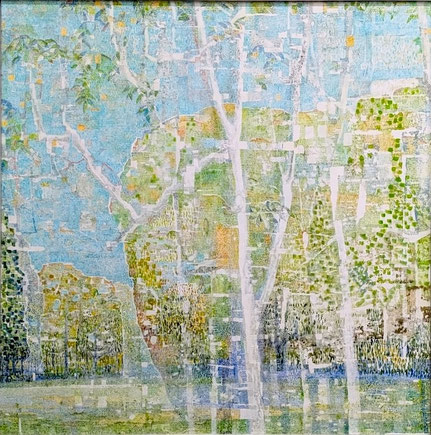
File 14: The Wind Sings, Mayura Kawai, 2025
1. 詳細版批評
記述
カワゐマユラの『かぜうたう』は、繊細な矛盾の上に成り立っている。視覚的には軽やかで、ほとんど溶け去りそうでありながら、キャンバス全体には緻密な筆致が施されている。淡い青色が、風化した空や水面、あるいは大気のヴェールのように画面の大部分を占める一方、緑、黄色、白、そして落ち着いたアースカラーが、不規則な筆跡の領域を形成している。この絵画は、単一の安定した解釈を拒む。縦に走る白い部分は、木の幹、小道、亀裂、流れ、あるいは露出した下地を思わせる。これらの線的な形態は、構図を支配するというよりはむしろそれを中断し、さもなくば小さな反復的な筆致で埋め尽くされた表面に、通路を切り開いている。この作品のエネルギーは、地図と森、表面と深み、侵食と成長との間のこの揺れ動きから生まれている。視線は絵画の上を横方向に移動し、やがて突然、より濃い青や緑の領域へと落ち込む。それはまるで、葉陰の下の影や、浅瀬の水面の反射に出くわすかのようだ。
表面は触覚的で、層を成しているように見える。多くの痕跡は、流れるような筆致というよりは、こすられたり、刷り付けられたり、削り取られたりしたような質感を持っており、キャンバスにパリンプセストのような印象を与えている。この絵画は風を直接描写するのではなく、拡散、希薄化、中断を通じて風を感知可能にしている。このタイトルが説得力を持つのは、構図が輪郭ではなく圧力によって組織化されているように見えるからだ。色は集まり、緩み、散らばり、そして再形成される。その叙情性は、この落ち着きのない不安定さに依拠している。
文脈づけ
作品のタイトル『かぜうたう』は、狭義の物語的文脈ではなく、環境的かつ感覚的な文脈を喚起する。目に見える証拠を超えて伝記的あるいは歴史的な枠組みを強要することなく、この絵画は、風景を単なる眺めとしてではなく、雰囲気、記憶の場、あるいは生態学的関係として扱う現代的な傾向の中に位置づけられる。それは、固定された距離から観察される風景として自然を提示するものではない。その代わりに、没入の状態を我々に与える。光、植生、空気、湿気、そして動きが、互いに浸透し合う力として現れる。
ギャラリーでの展示の仕方も重要だ。淡い色の額縁と無地の壁が静けさを際立たせ、比較的大きな正方形のフォーマットは、装飾パネルではなく環境として機能するのに十分なスケールを画像に与えている。鑑賞者は、抽象的なパターンでも従来の風景画でもない、その両者の境界に立つ。したがって、その文脈は単なる「自然画」ではなく、抽象化を経た後の風景に対する現代的な再考であり、そこでは自然界が断片、痕跡、感覚的な残滓を通じて遭遇される。
分類
様式的には、『かぜうたう』はリリカル・アブストラクション、抽象風景画、プロセス志向の絵画に近い位置づけとなる。これは、風景を写実ではなくリズムへと変換する作品群との親和性を持つ。淡い色彩のフィールド、断ち切られた垂直線、そして画面全体に広がる筆跡は、絵画が世界への窓というより、大気のような膜となる伝統を想起させる。しかし、この作品は抽象に完全に屈服してはいない。その緑や青、幹のような白、そして点在する黄色のアクセントは、観る者を想像上の林、海岸線、庭園、あるいは風雨に満ちた空き地の近くに留めておくのに十分な参照性を保っている。
この緊張関係により、本作は風景と抽象の旧来の区分を拒む近現代作品の系譜に位置づけられる。古典的な意味での遠近法的な奥行きには関心が向いていない。その代わりに、奥行きは密度、半透明性、そして重層化によって生み出されている。本作の分類が重要であるのは、その成功が描写の正確さによって測られるべきではなく、自然の感覚を絵画的構造へと変換できているかどうかにあるからだ。
解明
最も明確に確認できるモチーフは、垂直な白い形態、青色の大気的な領域、緑色の塊、黄色のアクセント、そして格子状あるいは細胞状に配置された小さなマークである。垂直な白い部分は木や枝と読み取れるが、亀裂や小道、あるいは露出した光の貯蔵庫としても機能している。緑色の領域は葉、苔、あるいは陸地を暗示し、青色の領域は空、水、あるいは空気を暗示する。黄色のタッチは、花、葉、反射光、あるいは色調の閃光といった、小さな光の脈動のように振る舞う。
この絵画のモチーフ体系は意図的に不安定である。各マークに固定された象徴的役割を割り当ててはいない。その代わりに、一つの視覚的記号が別の記号へと滑り込むようにしている。垂直の白は、幹であり、突風であり、引っかき傷であり、開口部でもある。緑の塊は、葉であり、地形であり、質感でもある。この不安定さは曖昧さではない。それは作品の語義論的方法なのだ。モチーフは、言語によってカテゴリーに固定される前の、動きの中で知覚される自然の記号のように機能する。
解釈
この絵画は、風を物体としてではなく、知覚を再編成する力として解釈している。風は直接描くことはできない。それは、風が触れるものから推し量らなければならない。カワゐの功績は、不在を能動的なものにした点にある。このイメージは、動きの痕跡で満たされている。断続的な線、散らばった色彩、曖昧になった境界、そして風雨によって部分的に消されたかのような表面だ。タイトルの音楽的比喩は極めて重要である。この絵画は風を描いているのではなく、風を楽譜に記しているのだ。その痕跡は、淡い大気の五線譜に配された音符のように振る舞う。
この作品が固有性を拒むことから、より広範な意味が浮かび上がる。ここでの自然は、記念碑的でも、絵画的でも、所有可能なものでもない。それは儚く、関係性に基づくものである。鑑賞者は、一度に把握することはできず、視覚的に「聴く」ことしかできない世界と出会う。ここで、この絵画の静けさは概念的に強さを帯びる。それは、精査というよりは、聴くことに近い注意深い見方を求めているのだ。風景は視覚によって掌握されるのではなく、リズム、中断、そして共鳴を通じて受け取られる。
分析
この絵画の形式的な構成は、その概念的論理を強化している。全面に広がる表面は、視線が単一の中心に落ち着くのを防ぎ、一方で白い垂直線は、画面を囲い込むことなく構造化する間隔を作り出している。これにより、拡散と構造の間に生産的な緊張が生まれる。青のパッセージは作品を外へと開く一方、緑や黄土色の痕跡はそれを物質的な密度へと引き戻す。下部の帯は、より暗く圧縮されており、まるで地平線のように振る舞うが、堅固な大地となるにはあまりにも不安定だ。したがって、この絵画は中間的な空間的状態を維持している。空とも、森とも、地図とも、記憶とも、完全には言い切れない状態だ。
その最も強い構造的矛盾は、脆さと執拗さの間にある。色調は穏やかだが、表面は執拗だ。作品は軽やかに感じられるが、蓄積された労働によって構築されている。この矛盾が、作品のタイトルに深みを与える。「うたう」とは、ここでは単なる甘美さではない。それは反復であり、振動であり、抵抗を貫いて流れる息吹である。この絵画が成功しているのは、その素材が、その名が示す現象を体現しているからだ。風は単に描かれているわけではない。それは分散した圧力、視覚的な震え、そして多孔質な構造へと翻訳されている。
評価
『かぜうたう』は、その形式言語、タイトル、物質的な表面、そして環境との連想が、並外れた一貫性をもって融合しているため、静かに完成された絵画である。その野心は劇的なスペクタクルではなく、知覚的な調和にある。つまり、認識が固まる前に、形成され、そして消散していく雰囲気を鑑賞者に感じさせたいと願っているのだ。この目的において、本作は極めて成功している。この作品の淡い色調は単なる装飾に終わってしまってもおかしくなかったが、その表面の密度と、パターンと風景の間の緊張感が、作品に深みを与えている。その象徴的な経済性も的確であり、画像を単なる挿絵に還元することなく、生態学的・感覚的な解釈のための十分な手がかりを残している。
この絵画の価値は、繊細さを能動的なものにする能力にある。それは叫んだり、物語を語ったり、固定された意味を押し付けたりはしない。見る行為が聴く行為となるような場を創り出すのだ。抽象と風景の統合として、それは説得力があり、洗練され、感情に響くものである。
2. 洗練版批評
カワゐマユラの『かぜうたう』は、抽象化された風景としてではなく、可視化された天候 [1] として理解されたときに最も力を発揮する。この絵画は風を絵画的な挙動へと変換している。淡い青が画面を緩め、白い垂直線が突風や木の幹のようにそれを切り裂き、黄緑色の塊は、風に揺らされる葉のように不規則に集まり、散っていく。その表面は受動的な大気ではなく、作り込まれた、抵抗力のある皮膚なのだ。したがって、この絵画の繊細さは欺瞞的である。その柔らかな色彩の層の下には、中断、振動、反復という厳格な構造が横たわっている。
この作品は、絵画的な表現を断固として避けている。安定した視点から所有し得る情景として自然を提示するのではない。その代わりに、不安定さを通じて没入感を生み出す。鑑賞者は森、地図、反射、記憶の間を漂わされ、決してそのイメージを単一の参照対象に還元することを許されない。これこそが、この絵画の最も説得力のある成果である。すなわち、風景を単なる眺めではなく、関係性の状態として扱っている点だ。その筆跡は、単純な図像的な方法で風を象徴しているわけではない。それらは風そのもののように振る舞い、境界を移ろわせ、固いものを震えへと変えるのだ。
この絵画が成功しているのは、その形式と意味が不可分だからだ。浅い読み方では、単にその雰囲気の美しさを称賛するだろうが、それはその鋭い知性を捉え損なっている。『かぜうたう』は単に美しいわけでも、単なる装飾品でもない。それは、目に見えない力の圧力の下で知覚がいかに変化するかについての、厳密な研究なのである。その淡く静かな佇まいに力強さがあるのは、表面、リズム、色彩、そしてタイトルに至るまで、あらゆる要素が同じ感覚的な命題に向けて機能しているからだ。すなわち、世界は固定できない場所でこそ最も生き生きとしているのだ。
3. 一文批評
「『かぜうたう』は、そよ風を青緑色のフーガへと変え、風景が視界に落ち着く前に、その風景に唸り声を上げさせる。」
[1] 原文の英単語weatherには風・光・湿気・空気の動きなどを含む大気というニュアンスも含むものと思われる。
1. Full-Length Critique
Description
Mayura Kawai’s The Wind Sings is built from a delicate contradiction: it is visually airy, almost dissolving, yet densely worked across the whole canvas. Pale blue occupies much of the surface like a weathered sky, a body of water, or a veil of atmosphere, while green, yellow, white, and muted earth tones gather into an irregular field of marks. The painting resists a single stable reading. Its vertical white passages resemble tree trunks, paths, cracks, currents, or exposed underlayers. These linear forms do not dominate the composition so much as interrupt it, opening channels through a surface otherwise packed with small, repeated gestures. The work’s energy comes from this oscillation between map and forest, surface and depth, erosion and growth. The eye moves laterally across the painting, then suddenly drops into pockets of darker blue or green, as if encountering shadows beneath foliage or reflections in shallow water.
The surface appears tactile and layered. Many of the marks have a rubbed, printed, or scraped quality rather than a fluidly brushed one, giving the canvas the feeling of a palimpsest. The painting does not describe wind directly; instead, it makes wind perceptible through dispersion, thinning, and interruption. The title becomes persuasive because the composition seems to have been organized by pressure rather than by contour: color gathers, loosens, scatters, and re-forms. Its lyricism depends on this restless instability.
Contextualization
The work’s title, The Wind Sings, invites an environmental and sensory context rather than a narrowly narrative one. Without imposing a biographical or historical frame beyond the visible evidence, the painting can be situated within contemporary tendencies that treat landscape less as a view than as an atmosphere, a memory field, or an ecological relation. It does not present nature as scenery observed from a fixed distance. Instead, it gives us a condition of immersion: light, vegetation, air, moisture, and motion appear as interpenetrating forces.
The gallery presentation also matters. The painting’s pale frame and neutral wall intensify its quietness, while the relatively large square format gives the image enough scale to operate as an environment rather than a decorative panel. The viewer stands before something that is neither abstract pattern nor conventional landscape, but a threshold between the two. Its context is therefore not simply “nature painting,” but a contemporary rethinking of landscape after abstraction, where the natural world is encountered through fragments, traces, and sensory residue.
Classification
Stylistically, The Wind Sings belongs near lyrical abstraction, abstract landscape, and process-oriented painting. It has affinities with works that translate landscape into rhythm rather than representation. The pale chromatic field, broken verticals, and all-over mark-making recall traditions in which painting becomes less a window onto the world than an atmospheric membrane. Yet the work does not surrender fully to abstraction. Its greens and blues, its trunk-like whites, and its dispersed yellow notes retain enough referential pull to keep the viewer near an imagined grove, shoreline, garden, or weather-filled clearing.
This tension places the painting in a lineage of modern and contemporary works that refuse the old division between landscape and abstraction. It is not interested in perspectival depth in the classical sense. Instead, depth is produced by density, translucency, and superimposition. The work’s classification matters because its success should not be measured by descriptive accuracy, but by whether it converts natural sensation into pictorial structure.
Elucidation
The most verifiable motifs are vertical white forms, blue atmospheric fields, green clusters, yellow accents, and a gridded or cellular distribution of small marks. The vertical whites can be read as trees or branches, but they also function as fissures, paths, or exposed reserves of light. The green areas suggest foliage, moss, or land mass, while the blue zones suggest sky, water, or air. The yellow touches behave like small pulses of illumination: flowers, leaves, reflected light, or tonal sparks.
The painting’s motif system is deliberately unstable. It does not assign each mark a fixed symbolic role. Instead, it lets one visual sign slide into another. A white vertical is at once trunk, gust, scratch, and opening. A green cluster is at once leaf, terrain, and texture. This instability is not vagueness; it is the work’s semantic method. The motifs operate like natural signs perceived in motion, before language has fixed them into categories.
Interpretation
The painting interprets wind not as an object but as a force that reorganizes perception. Wind cannot be painted directly; it must be inferred from what it touches. Kawai’s achievement lies in making absence active. The image is filled with evidence of movement: broken lines, scattered color, softened boundaries, and a surface that seems partially erased by weather. The title’s musical metaphor is crucial. The painting does not show the wind; it scores it. Its marks behave like notes distributed across a pale atmospheric staff.
A broader meaning emerges from the work’s refusal of solidity. Nature here is not monumental, picturesque, or possessable. It is fugitive and relational. The viewer encounters a world that cannot be grasped all at once, only listened to visually. This is where the painting’s quietness becomes conceptually strong. It asks for an attentive mode of looking closer to listening than inspection. The landscape is not mastered by sight; it is received through rhythm, interruption, and resonance.
Analysis
The painting’s formal organization reinforces its conceptual logic. The all-over surface prevents the eye from settling on a single center, while the white verticals create intervals that structure the field without enclosing it. This produces a productive tension between diffusion and architecture. The blue passages open the work outward, while the green and ocher marks pull it back toward material density. The lower band, darker and more compressed, acts almost like a ground line, but it is too unstable to become firm earth. The painting therefore sustains an in-between spatial condition: not quite sky, not quite forest, not quite map, not quite memory.
Its strongest structural contradiction is between fragility and insistence. The palette is gentle, but the surface is persistent; the work feels light, yet it has been built through accumulated labor. This contradiction deepens the title. “Singing” is not merely sweetness here. It is repetition, vibration, breath moving through resistance. The painting succeeds because its materials enact the phenomenon it names. The wind is not illustrated; it is translated into dispersed pressure, visual tremor, and porous structure.
Evaluation
The Wind Sings is a quietly accomplished painting because its formal language, title, material surface, and environmental associations converge with unusual coherence. Its ambition is not dramatic spectacle, but perceptual attunement: it wants to make the viewer feel an atmosphere forming and dissolving before recognition hardens. In this aim, it is highly successful. The work’s pale palette could have become merely decorative, but the density of its surface and the tension between pattern and landscape give it depth. Its symbolic economy is also well judged; it leaves enough cues for ecological and sensory interpretation without reducing the image to illustration.
The painting’s value lies in its ability to make delicacy active. It does not shout, narrate, or impose a fixed meaning. It creates a field in which looking becomes a form of listening. As a synthesis of abstraction and landscape, it is persuasive, refined, and emotionally resonant.
2. Refined Critique
Mayura Kawai’s The Wind Sings is strongest when understood not as a landscape abstracted, but as weather made visible. The painting converts wind into pictorial behavior: pale blue loosens the field, white verticals cut through it like gusts or tree trunks, and green-yellow clusters gather and disperse with the irregularity of leaves disturbed by air. Its surface is not passive atmosphere; it is a worked, resistant skin. The painting’s delicacy is therefore deceptive. Beneath its soft chromatic register lies a rigorous structure of interruption, vibration, and recurrence.
The work decisively avoids the picturesque. It does not offer nature as a scene to be possessed from a stable viewing point. Instead, it produces immersion through instability. The viewer is made to hover between forest, map, reflection, and memory, never allowed to reduce the image to one referent. This is the painting’s most convincing achievement: it treats landscape as a relational condition rather than a view. Its marks do not symbolize wind in a simple iconographic way; they behave as wind behaves, shifting boundaries and turning solid things into tremors.
The painting succeeds because its form and meaning are inseparable. A weaker reading would praise it merely for atmospheric beauty, but that misses its sharper intelligence. The Wind Sings is not simply pretty, nor merely decorative; it is a disciplined study of how perception changes under the pressure of invisible forces. Its pale quietness carries force because every element—surface, rhythm, color, and title—works toward the same sensory proposition: the world is most alive where it cannot be fixed.
3. One-Liner
"The Wind Sings turns a breeze into a blue-green fugue, letting the landscape hum before it ever settles into view."
注:作品画像と付随情報(作家名、作品タイトル、技法)だけを入力して得られた英文出力を和訳している(その際に作家名と作品タイトルを修正)。詳しいことは論文[1]、またはFile 01やFile 01aを参照してください.
[1] T. Arita, W. Zheng, R. Suzuki, and F. Akiba, "Assessing LLMs in Art Contexts: Critique Generation and Theory of Mind Evaluation", arXiv, 2025 (doi: 10.48550/arxiv.2504.12805).
作家からのコメント
生成された批評は、風景のイメージにいろいろなイメージを積層するという点など、制作の意図を正しく読み解いていて、驚きです。画像をインプットしての批評に可能性を感じます。