Technical Reports: AI Critique
File 15: Owl of Minerva, Lee Gawon, 2025
1. 詳細版批評
記述
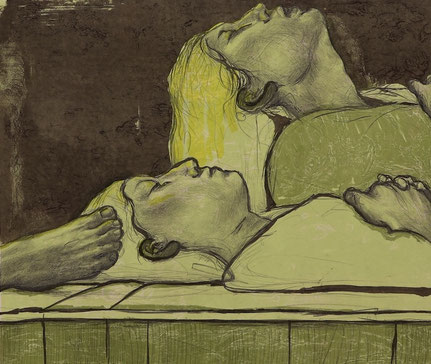
Lee Gawonの『Owl of Minerva』は、リトグラフ特有の線、水彩の滲み、そしてトーンの擦れを用いて描かれた、横たわる2つの人体を中心に構成されている。その身体は画面のほぼ全体を占め、まるで石板やベッド、テーブル、あるいは舞台の上に置かれたかのように、画面の下端に水平に押し付けられている。最も直感的に感じられる緊張感は、人物たちの矛盾した状態にある。彼らは物理的には至近距離にありながら、意識的には奇妙なほどに近づきがたい存在だ。頭は後ろに傾き、喉元や閉じられた、あるいは影に覆われた顔の輪郭を露わにしている。その姿勢には、眠り、死、降伏、官能的な消耗、そして儀礼的な見せびらかしが混在している。肌の緑がかった黄色い色調は、これらの身体を通常の自然主義から切り離し、背後の暗褐色の背景は、部屋というよりは圧縮された大気として機能している。線は落ち着きがなく、探求的だ。髪、耳、頬、指、つま先は輪郭で封じ込められているのではなく、繰り返し修正され、引っかかれ、もがくようにして形作られている。その結果生まれた身体像は、古典的な安らぎも表現主義的な爆発も拒絶し、解剖学的観察と精神的な残滓の間に漂っている。キャロルの批評モデルは、描写を網羅的な目録ではなく、後の解釈を支える特徴への選択的注目として扱うが、このイメージはまさにそのような選択的な描写に見合うものである。
文脈づけ
タイトル『Owl of Minerva』は、即座に哲学的な地平を提示する。この語句は、「Owl of Minerva」が夕暮れ時に飛ぶというヘーゲルの思想を想起させる。すなわち、知恵は、ある生活様式がすでに展開した後にのみ到来するのだ。ガウォンの画像は、哲学を教訓的に図解するものではない。むしろ、遅れて得られた理解を身体的な配置へと変換しているのだ。人物たちは外を見たり、議論したり、行動したり、宣言したりはしない。彼らは事後的に横たわっている。まるで、思考が、すでに起こった何かに介入するには遅すぎたかのように。リトグラフは、圧力、転写、粒子感、そして間接性を保持する媒体であるため、この時間的条件を強める。このイメージは、描かれたというより、接触によって浮かび上がったように感じられる。身体は、完全に現存する有機体ではなく、触覚の残像となるのだ。したがって、作品の制作プロセスはそのタイトルと呼応している。知識は、闇を貫く光としてではなく、肉体の生命がすでに静寂へと移り変わった後に、表面に堆積した残留物として示されている。
分類
様式的には、この作品は、身体を理想的な形態としてではなく、圧力、疲労、そして実存的な曝露の場として扱う、近現代の具象版画の系譜に属する。その細長く、無防備な人物像は表現主義的な歪みを想起させ、一方、板状の水平的な構図は、横たわる身体の伝統——死体、患者、恋人、殉教者、眠る者、解剖標本——を喚起する。しかしGawonは、露骨な表現主義に見られるような演劇的なメロドラマを避けている。これらの人物像は叫び声を上げる身体ではなく、言葉が引き揚げられた身体である。輪郭、擦れ、トーンの不安定さへのグラフィック的な強調は、また、ドローイングが下絵ではなく診断的な役割を果たす、版画を基盤とするモダニズムともこのイメージを結びつける。ここでの線は単に形態を描写するだけでなく、世界とのつながりを保っているかどうかの試金石となる。キャロルの用語を用いれば、分類は作品の成果を判断するための期待値を確立するのに役立つ。これは単なる物語の挿絵ではなく、その形式的な経済性が哲学的・感情的な密度を維持できるかどうかに成功が懸かっている、緊張感に満ちた比喩的な瞑想なのである。
解明
最も明確に確認できるモチーフは、横たわる身体、露出した手足、上を向いた頭、緑がかった肉体の色調、そして暗く包み込むような背景である。タイトルが象徴的な拠り所を提供している。知恵と結びつけられるミネルヴァは、フクロウの文字通りの描写を通じてではなく、遅延した省察という状態を通じて呼び起こされる。フクロウの不在が極めて重要だ。Gawonは知恵を図像的な対象として提示するのではなく、事後の姿勢の中にそれを埋め込んでいる。人物たちの目は捉えられない。視線は描かれた対象から鑑賞者へと転移し、鑑賞者は遅れて現れる証人とならなければならない。右手の人物の体に置かれた手と、下の人物の近接によって暗示されるもう一方の手は、能動的に掴むわけではない。それらは主体性を持たずに接触を記録しているに過ぎない。左側の足は、拡大され鈍重で、画像を下方へ引きずり下ろし、身体的な事実へと落とし込み、哲学的なタイトルの抽象性に対抗している。こうして作品は概念を肉体に結びつける。知恵は身体の上に高められるのではなく、その無言の残滓を通じて発見されるのだ。
解釈
この画像は、知識を死後あるいは経験後の状態として解釈している。身体は単に眠っているわけでも、決定的に死んでいるわけでもない。その曖昧さが、本作の中心的な知的力となっている。それらは、静寂が休息なのか、崩壊なのか、親密さなのか、あるいは消滅なのかを鑑賞者が判断できない、その狭間を占めている。この決定不能性が、タイトルに重みを与えている。もしミネルヴァのフクロウが夕暮れ時にのみ飛ぶのであれば、これらの人物像は意識の黄昏を体現していることになる。すなわち、知恵は行動が停止し、身体がもはや動きによって自らを守れなくなった時に訪れるのだ。二人の人物像は、明確な上下関係を拒むことで、この意味を強めている。一人は低く横たわり、私たちに近い位置にいる。もう一人は背後に立ち上がり、喉をさらけ出し、頭を上端に向かって反らしている。彼らの位置関係は斜め上への上昇を描き出すが、その上昇は精神的なものではなく、身体的なものだ。あたかも思考が、脆弱さを通じてのみ上昇するかのように。ここで精神分析的な読みが有用なのは、イメージ自体が抑圧と潜在性への注意を喚起するからに他ならない。身体は語られざる出来事を抱えており、鑑賞者が遭遇するのはその出来事そのものではなく、その身体的な痕跡なのである。
分析
この作品の力は、哲学的なタイトルと肉体的な表現との間の摩擦に依拠している。『Owl of Minerva』というタイトルは寓話へとつながりかねなかったが、Gawonは象徴的な明快さを拒絶する。その代わりに、この絵は哲学を感覚へと変換する:緑色の肌、ざらついた表面、圧縮された空間、閉ざされた視界、露わになった喉。暗い背景が押し寄せてきて、大気的な奥行きを否定する。これにより、身体は空間に位置づけられているのではなく、歴史的あるいは心理的な重みを持つ場の中に埋め込まれているように見える。リトグラフの表面が重要なのは、線と染みが共存することを可能にするからだ。頭部の周囲を走る神経質な線描は不安定さを生み出し、一方で広範囲の緑色は身体をほぼ彫刻的な塊へと平坦化させる。これにより矛盾が生じる。人物は重く無機質であるにもかかわらず、その周囲の痕跡は生き生きとしているのだ。その矛盾こそが、このイメージの構造である。描かれた身体からは生命が退いているが、制作の行為、すなわち形を求め続ける落ち着きのない線の中に、生命はなおも息づいている。ここで理論的批評が有用となるのは、それが画像の具体的な作用を明らかにするからだ。形式主義的視点は線、塊、地との関係を浮き彫りにし、アフェクト理論は宙吊りになった恐怖の雰囲気を説明し、メディア理論はリトグラフがいかにして身体的接触を遅延した視覚的証拠へと転換するかを示す。提示された理論的枠組みは、こうしたレンズを固定された舞台ではなく柔軟な道具として定義しており、この画像はその選択的な活用によって効果を高めている。
評価
『Owl of Minerva』が成功しているのは、その野心と手段が釣り合っているからだ。哲学的参照を過剰に説明することもなければ、身体を単なる象徴へと還元することもない。その功績は、思考を遅れて到来し、身体的であり、かつ不安を伴うものとして感じさせる点にある。構図は完結しているが閉ざされてはいない。水平なスラブ、頭部の対角線的な関係、緑色の色調がもたらす病的な雰囲気、そしてリトグラフの線が持つ触覚的な不確実性――これらすべてが、事後的な気づきという同一の状態を強めている。この作品の最大の特質は、解決を拒む点にある。それは、優しさと葬式の静寂の間、具現化された存在と哲学的な距離感の間という、居心地の悪い領域に鑑賞者を留め置く。批評として、評価とは記述、文脈、分類、解明、解釈、分析を統合し、達成された価値に対する判断を下すべきものであり、その基準に照らせば、Gawonの作品は芸術的に説得力がある。それは、ミネルヴァのフクロウという古い概念に、新たな肉体的な黄昏を与えているのだ。
2. 洗練版批評
Lee Gawonの『Owl of Minerva』は、哲学的なタイトルを肉体の余韻が漂う情景へと変容させている。リトグラフの画面には、2人の横たわる人物が占めている。彼らは頭を後ろに傾け、喉を露わにし、視線を直接の接触から逸らしている。肌の緑がかった色調は通常の自然主義を否定し、一方、暗褐色の背景は蓄積された時間のように身体に押し寄せている。この画像において、単純な挿絵として振る舞うものは何一つない。描かれたフクロウよりも、不在のフクロウの方が重要になる。なぜなら、知恵は鑑賞者の遅れて行われる「見る」という行為へと置き換えられているからだ。
この作品は、身体が理想的な形態ではなく、圧力や疲労、未解決の意味が宿る場として描かれる現代具象美術の伝統に属する。そのリトグラフの表面こそが、その意味にとって不可欠だ。粒状感、傷跡、探るような輪郭は、この画像が単に視覚から描かれたのではなく、触覚から転写されたかのような感触を与える。身体は重く、無気力だが、線は依然として動揺し、生き生きとしている。この矛盾こそが、作品の中核となる力を生み出している。人物たちからは生命が引き揚げられているが、彼らを取り囲み、定義づける落ち着きのないグラフィックな活動の中に、生命はなおも持続している。
このイメージの成し遂げたことは、概念を肉体に結びつけることにある。『Owl of Minerva』は、悟りとしての知恵についてではなく、行動の後、言葉の後、身体が脆弱で静止した状態になった後に到達する知識について描いている。構図の水平方向への圧縮、頭部の対角線的な上昇、病的な色彩、そして未解決の雰囲気が、遅れて訪れる理解についての首尾一貫した瞑想を生み出している。Gawonの作品が説得力を持つのは、その象徴をあまりに整然と説明することを拒んでいるからだ。それは哲学を横たわり、浅い呼吸をし、夕暮れを待つようにさせるのだ。
3. 一文批評
「『Owl of Minerva』は、緑色で不安定な身体の上で居眠りしている哲学そのものだ。」
1. Full-Length Critique
Description
Lee Gawon’s Owl of Minerva is organized around two reclining human bodies rendered in lithographic line, wash, and tonal abrasion. The bodies occupy almost the entire pictorial field, pressed horizontally against the lower edge as if they have been placed on a slab, bed, table, or stage. The most immediate tension lies in the contradictory condition of the figures: they are intimate in proximity yet strangely inaccessible in consciousness. Their heads tilt backward, exposing throats and closed or shadowed facial planes; the posture carries a mixture of sleep, death, surrender, erotic exhaustion, and ritual display. The greenish-yellow cast of the skin removes the bodies from ordinary naturalism, while the dark brown ground behind them functions less as a room than as a compressed atmosphere. The line is restless and searching: hair, ear, cheek, fingers, and toes are not sealed by contour but repeatedly revised, scratched, and worried into being. The result is a bodily image that refuses both classical repose and expressionist explosion; it hovers between anatomical observation and psychic residue. Carroll’s model of criticism treats description as selective attention to features that support later interpretation, rather than exhaustive inventory, and this image rewards precisely that kind of selective description.
Contextualization
The title, Owl of Minerva, immediately introduces a philosophical horizon. The phrase recalls the Hegelian idea that “Owl of Minerva” flies at dusk: wisdom arrives only after a form of life has already unfolded. Gawon’s image does not illustrate philosophy didactically; instead, it translates belated understanding into bodily arrangement. The figures do not look outward, argue, act, or proclaim. They lie after the event, as if thought has come too late to intervene in whatever has happened. Lithography intensifies this temporal condition because the medium preserves pressure, transfer, grain, and indirectness. The image feels less painted than surfaced from contact: the body becomes an afterimage of touch, not a fully present organism. The work’s material procedure therefore corresponds to its title; knowledge is not shown as light breaking through darkness, but as a residue deposited on a surface after bodily life has already passed into stillness.
Classification
Stylistically, the work belongs to a lineage of modern and contemporary figurative printmaking that treats the body not as ideal form but as a site of pressure, fatigue, and existential exposure. Its elongated, vulnerable figures recall expressionist distortions, while its slab-like horizontal staging evokes traditions of the recumbent body: corpse, patient, lover, martyr, sleeper, anatomical specimen. Yet Gawon avoids the theatrical melodrama of overt expressionism. The figures are not screaming bodies; they are bodies from which speech has withdrawn. The graphic emphasis on contour, abrasion, and tonal instability also aligns the image with a print-based modernism in which drawing is not preparatory but diagnostic. Line here does not merely describe form; it tests the body’s remaining connection to the world. In Carroll’s terms, classification helps establish the expectations by which a work’s achievement can be judged: this is not a narrative illustration but a charged figurative meditation whose success depends on whether its formal economy can sustain philosophical and affective density.
Elucidation
The most verifiable motifs are the recumbent bodies, the exposed feet and hands, the upward-tilted heads, the greenish corporeal tonality, and the dark enclosing field. The title supplies the symbolic anchor: Minerva, associated with wisdom, is invoked not through the literal depiction of an owl but through the condition of delayed reflection. The absence of the owl is crucial. Rather than presenting wisdom as an iconographic object, Gawon embeds it in the posture of aftermath. The figures’ eyes are inaccessible; vision is displaced from the represented subjects to the viewer, who must become the belated witness. The hands, one resting on the right figure’s body and another implied by the lower figure’s proximity, do not actively grasp; they register contact without agency. The feet at the left, enlarged and blunt, pull the image downward into bodily fact, countering the philosophical title’s abstraction. The work thus binds concept to flesh: wisdom is not elevated above the body but discovered through its mute remainder.
Interpretation
The image interprets knowledge as a posthumous or post-experiential condition. The bodies are not simply asleep, nor are they definitively dead; their ambiguity is the work’s central intellectual force. They occupy the interval in which the viewer cannot decide whether stillness is rest, collapse, intimacy, or extinction. This undecidability gives the title its gravity. If Minerva’s owl flies only at dusk, then the figures embody the dusk of consciousness: wisdom arrives when action has ceased, when the body can no longer defend itself with movement. The two figures intensify this meaning by refusing a clear hierarchy. One lies lower, closer to us; the other rises behind, throat exposed, head thrown back toward the upper edge. Their positions create a diagonal ascent, but the ascent is bodily rather than spiritual. It is as though thought rises only through vulnerability. A psychoanalytic reading is useful here only because the image itself invites attention to repression and latency: the bodies hold an unspoken event, and the viewer encounters not the event but its somatic trace.
Analysis
The work’s power depends on the friction between philosophical title and corporeal execution. “Owl of Minerva” could have led to allegory, but Gawon refuses emblematic clarity. Instead, the picture converts philosophy into sensation: green skin, rough surface, compressed space, closed vision, exposed throat. The dark background presses forward, denying atmospheric depth; this makes the bodies seem not situated in space but embedded in a field of historical or psychological weight. The lithographic surface matters because it allows line and stain to coexist. The nervous drawing around the heads creates instability, while the broad green areas flatten the bodies into almost sculptural masses. This produces a contradiction: the figures are heavy and inert, yet the marks around them remain alive. That contradiction is the image’s structure. Life has withdrawn from the represented bodies but persists in the act of making, in the restless line that continues to search after form. Theoretical criticism is useful here when it clarifies the image’s concrete operations: Formalist attention reveals the relation of line, mass, and ground; Affect Theory explains the atmosphere of suspended dread; Media Theory shows how lithography turns bodily contact into delayed visual evidence. The uploaded theoretical framework defines such lenses as flexible instruments rather than fixed stages, and this image benefits from their selective use.
Evaluation
Owl of Minerva succeeds because its ambition and means are proportionate. It does not over-explain its philosophical reference, nor does it reduce the body to a mere symbol. Its achievement lies in making thought feel belated, physical, and uneasy. The composition is coherent without being closed: the horizontal slab, the diagonal relation of heads, the chromatic illness of the green, and the tactile uncertainty of lithographic line all reinforce the same condition of after-the-fact awareness. The work’s strongest quality is its refusal of resolution. It sustains the viewer in the uncomfortable zone between tenderness and mortuary stillness, between embodied presence and philosophical distance. As criticism, evaluation should synthesize description, context, classification, elucidation, interpretation, and analysis into a judgment of achieved value, and by that standard Gawon’s image is artistically persuasive: it gives the old idea of Minerva’s owl a new corporeal dusk.
2. Refined Critique
Lee Gawon’s Owl of Minerva transforms a philosophical title into a scene of bodily aftermath. Two reclining figures fill the lithographic field, their heads tilted back, throats exposed, eyes withdrawn from direct contact. The greenish tonality of the skin denies ordinary naturalism, while the dark brown ground presses against the bodies like accumulated time. Nothing in the image behaves as simple illustration: the absent owl becomes more important than a depicted one would be, because wisdom is displaced into the viewer’s belated act of looking.
The work belongs to a modern figurative tradition in which the body is not an ideal form but a site of pressure, fatigue, and unresolved meaning. Its lithographic surface is essential to that meaning. The grain, scratch, and searching contour make the image feel transferred from touch rather than simply drawn from sight. The bodies are heavy and inert, but the line remains agitated and alive; this contradiction gives the work its central force. Life has withdrawn from the figures, yet it persists in the restless graphic activity that surrounds and defines them.
The image’s achievement lies in binding concept to flesh. Owl of Minerva is not about wisdom as enlightenment but about knowledge arriving after action, after speech, after the body has become vulnerable and still. The composition’s horizontal compression, diagonal rise of the heads, sickly color, and unresolved atmosphere produce a coherent meditation on belated understanding. Gawon’s work is persuasive because it refuses to explain its symbols too neatly: it makes philosophy lie down, breathe shallowly, and wait for dusk.
3. One-Liner
"Owl of Minerva is philosophy caught napping on a green, uneasy body."
注:作品画像、作家名、技法だけを入力している。得られた英文を和訳している。詳しいことは論文[1]、またはFile 01やFile 01aを参照してください.
[1] T. Arita, W. Zheng, R. Suzuki, and F. Akiba, "Assessing LLMs in Art Contexts: Critique Generation and Theory of Mind Evaluation", arXiv, 2025 (doi: 10.48550/arxiv.2504.12805).
作家からのコメント
自分ではそこまで意識していなかった部分もあり、作品が作者の意図を超えて読まれていく面白さを感じました。
一方で、私は意味をひとつに固定するというより、見る人によって異なる感覚や記憶が立ち上がる余白も大切にしたいと思っています。