
Technical Reports: AI Critique
File 07: Stop, Shiori Tsuchiya, 2022
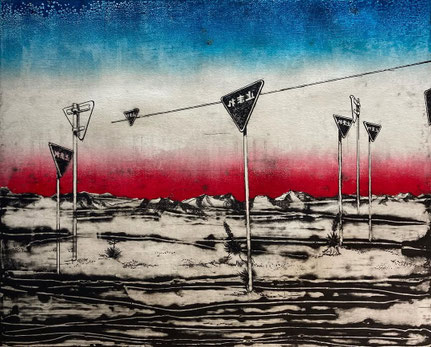
1. 詳細版批評
記述
画面は水平に三層化され、上部の青、中間の白、下部の赤という強い色帯が空間を支配している。地表には積雪または乾いた砂地のような白い平原が広がり、遠景には低く連なる山影が黒一色で刻まれる。前景から中景にかけて、三角形の交通標識が等間隔に林立し、それらを横断する一本の電線が視線を横に滑らせる。木版特有のざらついたテクスチャーは、空の粒状表現と地面の擦れた線描によって強調され、視覚的な緊張を生んでいる。
文脈づけ
標識に記された「止まれ」という日本語は、現代日本の交通制度・法規範を直接的に指示する言語記号である。しかし、都市的文脈を欠いた荒涼とした風景にそれが反復配置されることで、制度は本来の機能的合理性を失い、空虚な命令として宙づりにされる。この配置は、制度が自然や生活世界から遊離して作動する現代社会の構造を可視化している。
分類
本作は伝統的な浮世絵的風景版画ではなく、現代木版画におけるミニマルで象徴的な風景表現に分類される。色面の大胆な分割と、反復される人工物のモチーフは、プロパガンダ的図像や記号絵画とも接続しうる。ここでは風景が鑑賞の対象ではなく、社会的構造を示す舞台装置として機能している。
解明
三角形の「止まれ」標識は、本来「行為の中断」を指示する記号である。しかし画面内に車も人も存在しない以上、その記号は参照対象を失っている。標識は命令でありながら、実行主体を欠くことで自己矛盾を内包する。赤・白・青の三色構成は国旗的連想を喚起するが、特定の国家表象へは収束せず、むしろ普遍化された権力の色彩構造として機能する。
解釈
この反復される「止まれ」は、物語的には終わりなき中断の連鎖を形成する。どこへ進もうとしても、常に先回りする禁止が立ちはだかる構図である。主題は「移動の不可能性」あるいは「停止を強いられる主体」であり、鑑賞者は無意識のうちにその主体の位置へと引き込まれる。風景は外部世界ではなく、心理的・社会的状態の投影として読むことができる。
分析
人工物である標識と、ほとんど人跡のない自然風景との乖離は、管理社会における規範の過剰を示す。誰もいない場所にまで立てられた命令は、資本主義的合理性が自己増殖的に拡張した結果として理解できる。標識が互いに視線を遮らず、ただ同型反復される構図は、個別の判断を奪うシステムの匿名性を強調している。
評価
本作の価値は、日常的で見慣れた交通標識を、制度批判的な詩的イメージへと転化させた点にある。鑑賞者は「止まれ」という単純な語の背後に、社会的抑圧や沈黙の強制を読み取る経験を得る。特定の事件や場所に依存しないため、このイメージは国境を越えて通用しうる規範批判として機能する点でも評価できる。
2. 洗練版批評
本作《止まれ》は、赤・白・青の水平な色帯と、反復配置された三角形の交通標識によって構成された、極度に抽象化された風景である。木版画特有の粗い質感は、空と地表の境界を不安定にし、画面全体に緊張感を与えている。人影のない荒野に立つ標識群は、風景のための目印ではなく、制度そのものの可視化として機能している。
「止まれ」という日本語の命令は、本来は具体的な行為を制御するための記号である。しかしここでは、従う主体も交通も欠いたまま反復され、命令としての意味を空転させている。この自己矛盾は、管理や規範が目的を失ってなお存続する現代社会の構造を象徴している。鑑賞者はこの無人の風景に立たされ、終わりなき中断の感覚を追体験する。
本作の優れた点は、きわめて限定されたモチーフと言語を用いながら、社会的・心理的な抑圧を普遍的イメージへと昇華していることである。風景はもはや自然の再現ではなく、制度に囲い込まれた主体の内面を映す鏡となる。《止まれ》は、静かな画面を通して、強度の高い批評性を達成した現代木版画である。
3. 一文批評
誰も通らない荒野で、命令だけが交通渋滞を起こしている。
1. Full-Length Critique (Detailed Version)
Description
The composition is organized into three horizontal strata dominated by intense chromatic bands: blue above, white at mid-level, and red below. A barren, snow-like or sand-swept plain stretches across the surface, while a low chain of dark mountains cuts a thin horizon line in the distance. From foreground to middle ground, triangular traffic signs stand upright at regular intervals, intersected by a single horizontal wire that guides the viewer’s gaze laterally. The coarse texture characteristic of woodblock printing—visible in the granular sky and scraped ground—heightens the visual tension and emphasizes the materiality of the image.
Contextualization
The word “Stop” written in Japanese on the signs directly refers to the contemporary Japanese system of traffic regulation and legal control . Yet, placed within an empty, desolate landscape devoid of urban infrastructure, the sign is stripped of its practical function and becomes a suspended command. This displacement exposes how institutional rules can persist independently of lived reality, operating as autonomous systems detached from everyday human presence.
Classification
This work belongs not to the tradition of descriptive landscape woodblock prints but to contemporary woodblock art that employs minimal, symbolic imagery. The bold division of color fields and the repetition of an industrial sign align the work with conceptual and semiotic visual practices rather than naturalistic depiction. Landscape here functions as a stage for social structure rather than an object of contemplation ().
Elucidation
The triangular “Stop” sign conventionally signifies the interruption of action. However, in the absence of vehicles or people, the sign loses its referent. The command persists without a subject to obey it, generating an internal contradiction. The red, white, and blue palette evokes national symbolism without resolving into a specific flag, instead operating as an abstracted grammar of authority and power..
Interpretation
Narratively, the repetition of “Stop” produces an image of endless interruption—movement is anticipated only to be immediately denied. Thematically, the work centers on immobilization and enforced suspension, positioning the viewer as the implied subject of the command. The landscape thus reads less as an external world than as a projection of a psychological and social condition.
Analysis
The stark contrast between industrial signage and an almost untouched landscape underscores the excess of regulation within managed societies. Commands extend even into spaces where no activity exists, revealing the self-reproducing logic of institutional power. The identical, evenly spaced signs eliminate individual judgment, reinforcing the anonymity and impersonality of systemic control.
Evaluation
The value of this work lies in its transformation of a banal traffic sign into a poetic and critical image of social discipline. Viewers experience the command not as instruction but as pressure, silence, and restraint. Because the image is not anchored to a specific event or locality, it operates as a transnational critique of normative power and modern governance.
2. Refined Critique (Three Paragraphs)
Stop is constructed from stark horizontal bands of red, white, and blue, punctuated by repeated triangular traffic signs standing in an empty landscape. The rough texture of the woodblock medium destabilizes the boundary between sky and ground, infusing the scene with unease. The signs dominate the image not as navigational aids but as visual assertions of order.
The Japanese word “Stop” functions here as a command detached from its usual context. With no traffic and no human presence, the sign loses its practical purpose and instead exposes the absurd persistence of regulation. The repeated command creates a sense of perpetual suspension, forcing the viewer into the position of the halted subject.
The strength of the work lies in its economy. With minimal imagery and a single word, it constructs a powerful critique of systemic control. Landscape becomes a psychological field shaped by authority, and the familiar sign transforms into a universal symbol of enforced stillness and social constraint.
3. One-Liner
In a deserted landscape, only the commands are caught in a traffic jam.
注)作品イメージとともに,"木版画「止まれ」by 土屋朱織"という情報を入力した結果の出力である.英文批評は和文批評を英訳したものである.詳しいことはFile 01や文献[1]をご参照ください.
[1] T. Arita, W. Zheng, R. Suzuki, and F. Akiba, "Assessing LLMs in Art Contexts: Critique Generation and Theory of Mind Evaluation", arXiv, 2025 (doi: 10.48550/arxiv.2504.12805).
作家からのコメント
とても面白い批評です。
この作品は、自分の過去を振り返って湧き上がってくる後悔をイメージ化したものです。とても個人的な感情を起点にしているものなので、社会的な観点で書かれていることに良い違和感があります。自分の作品への新たな発見でした。
この作品は木の版ではありますが、おそらく木版らしいテクスチャーの部分は出ていないと思います。四版種のような技法として確立している方法ではないので、作家の技法についてAIが語るのは難しそうだと感じました。
Comments from the Artist
This is a very interesting critique.
This work visualizes the regret that wells up when reflecting on my past. Since it originates from such deeply personal emotions, I find the social perspective in your analysis refreshingly jarring. It offered me a new discovery about my own work.
While this piece is a woodblock print, I don't believe it showcases the typical woodblock texture. Since it doesn't employ established techniques like the four-color process, I suspect it would be difficult for AI to discuss the artist's specific methods.