
Technical Reports: AI Critique
File 05: If I Grow Big Enough, I Can Save Everyone, Hazuki Tachibana, 2025
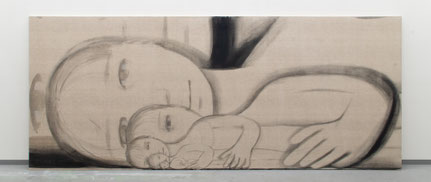
1. 詳細版批評
記述
橘葉月の《If I Grow Big Enough, I Can Save Everyone》(2025)は、横幅約4メートルにも及ぶ巨大なキャンバスに、圧倒的なスケールと情動の緊張を展開する作品である。アクリルと油彩が織りなす層は、厚塗りと薄塗りの対立を繰り返しながら、拡張と崩壊の文法を描く。リボンのように伸びゆく身体の断片は、救済への万能的欲望を象徴する無意識の夢想を呼び起こす。この終わりのない拡張のジェスチャーは、アニメ的な平面性と絵画的肉体性を結合させる現代日本絵画のシステムの中で機能している。
文脈づけ
本作はポスト・パンデミック期の日本に制作された。そこでは社会的不安や環境的脆弱さが人々の意識に深く刻まれている。「Save Everyone」というタイトルの願望は、集団的トラウマと「救う女性像」という日本的メディア神話の両方を反映する。しかし橘は、その構図を転倒させる。彼女の「救う者」は受動的な癒やし手ではなく、巨大な体躯で世界に立ち向かう反逆的な存在だ。さらに西洋の表現主義的筆致と東洋的線の抽象を融合させる彼女の語法は、ポストコロニアル的混淆性を帯びた新しいアイデンティティの宣言でもある。
分類
本作は、マルレーネ・デュマスの感情的具象絵画や、村上隆の「スーパーフラット」以後の再物質化運動と対話している。だが橘の筆致は、絵具そのものに倫理的闘争を刻みつける点で、むしろ震災以後の「身体と物質の再接続」を志向する画家たちの系譜に近い。
解明
「If I Grow Big Enough」という条件法のタイトルは、救済の実現を永遠に先送りする不安定な文法を持つ。繰り返し描かれる伸びた腕は、翼でもあり傷でもある。保護と自己崩壊の矛盾がそこに潜む。絵画行為そのものが、無意識の肥大化=自我の膨張という心理的儀式として現れる。さらに下層に透けて見える下描きや修正の痕跡は、生成過程を記録する「成長する作品」としての性格を示す。
解釈
この作品は、一人の存在が世界を包み込もうとして自己を溶かしていく神話的物語を描いている。主題的には、「共感の悲劇」――すべてを救おうとするあまり自己を犠牲にするという矛盾――が中心に据えられる。タイトルの「私」は性別を特定せず、ジェンダー的固定観念を超越する可塑的存在として現れる。
分析
日本社会における過労、孤立、罪悪感の文脈において、「救う」という欲望は同時に批判と共感の両義性を帯びる。巨大な身体表現は、見えない感情労働、特に女性に偏るケア労働の象徴である。作品全体は社会的コミュニケーションの場として機能し、芸術システムの中で現代的共感を媒介する。
評価
橘の達成は、脆さと壮大さを両立させた点にある。感情の繊細さを失うことなく、物理的スケールを通じて共感を神話的行為へと昇華している。鑑賞者の受容が広がるにつれ、この作品は個人的告白から集団的祈りへと変容する。その成功は「救うことの不可能性」をもってなお他者を包み込もうとする、現代的ケアの倫理を体現している。
2. 洗練版批評
橘葉月の《If I Grow Big Enough, I Can Save Everyone》は、圧倒的な横長キャンバスの中に、伸び広がる身体と感情のうねりを描く。アクリルと油彩が交錯し、絵具の厚みが「成長」と「崩壊」を同時に語る。画面全体には「みんなを救いたい」という無意識的な万能願望が流れ、それが画面の構造を動かしている。
本作は2025年という時代の空気を孕んでいる。ポスト・パンデミックの日本で、他者へのケアと自己喪失の境界を描く。橘は伝統的な「女性的優しさ」を覆し、救済者を巨大で不安定な存在として描く。西洋絵画史と日本的感性を融合させる筆致は、世界的文脈の中で独自の位置を占めている。「大きくなること」が救いを意味しながら同時に破滅を孕むという矛盾が、作品の根幹にある。
この絵画は、共感の限界を描く神話である。社会的疲弊や感情労働への批評性を保ちながらも、他者を包み込む優しさを失わない。そのスケールは単なる物理的拡大ではなく、倫理的・情動的な拡張である。橘の筆は、個人の願望を社会的希望へと変換し、現代絵画における「ケアの美学」を確立している。
3. 一文批評
世界を抱きしめようとして、自分ごと溶けていく巨人の子守唄。
1. Full-Length Critique (Detailed Version)
Description
Hazuki Tachibana’s If I Grow Big Enough, I Can Save Everyone (2025) stretches horizontally across nearly four meters, enveloping the viewer in a landscape of sprawling scale and emotional charge. The acrylic and oil layers create textural contrasts — thick impasto colliding with delicate washes — a grammar of surface that enacts expansion and collapse. The oversized, ribbon-like limbs and bodies, possibly distorted figures or vegetative forms, evoke a yearning for growth beyond human proportion, resonating with the unconscious fantasy of omnipotent rescue. This enlargement of form, looping endlessly along the canvas, participates in the systemic network of contemporary Japanese painting that merges anime-inflected figuration with monumental physical presence.
Contextualization
Painted in post-pandemic Japan, Tachibana’s generation navigates a culture haunted by vulnerability — environmental, social, and existential. The title’s desire “to save everyone” echoes both collective trauma and the female savior complex pervasive in Japanese pop media, where care often defines feminine heroism. Yet Tachibana’s monumental scale reverses that trope: the caregiver becomes a titan, her compassion an act of rebellion against passivity. In transnational context, her visual language dialogues with postcolonial hybridity — blending Western expressionist gesture with East Asian symbolic elongation — asserting a new identity that transcends cultural confinement.
Classification
The work belongs to the lineage of large-scale existential figuration, recalling Marlene Dumas’s emotional figural fields and Takashi Murakami’s superflat universe re-inflated into depth. Yet Tachibana’s insistence on physical paint as moral struggle situates her closer to post-3.11 (Fukushima) painters who re-materialize emotion in pigment.
Elucidation
Iconographically, the title’s conditional phrase “If I grow big enough…” introduces an unstable grammar — the impossible “if” that defers salvation. The repeated, stretching limbs can be read as both wings and wounds, gestures of protection and self-fragmentation. The act of painting itself mirrors psychic inflation, the ego’s dream of omnipotence turned into a painterly performance. Traces of underdrawing visible beneath translucent layers suggest a genetic process — a painting continuously remade, growing through self-revision.
Interpretation
Narratively, the painting enacts a myth of transformation: the self expanding to embrace the world yet dissolving under its own weight. Thematically, Tachibana’s work articulates the tragedy of empathy — that to save everyone, one must risk annihilation of the self. The title’s ambiguous “I” resists fixed gender; it inhabits fluid identity, reconfiguring gendered expectation through monumental scale.
Analysis
Within Japan’s social landscape of overwork, isolation, and collective guilt, the painting’s desire to “save” reveals both critique and compassion. The exaggerated corporeality becomes a metaphor for invisible social labor, particularly emotional labor disproportionately carried by women. The canvas functions as a social system: a feedback loop where the artist’s internal psychic charge materializes as cultural communication.
Evaluation
Tachibana achieves an extraordinary synthesis of vulnerability and monumentality — a rare success in contemporary figural art. The painting’s affective force lies in its balance of intimacy and scale: a whisper that fills the room. As reception expands, its meaning evolves — from private confession to collective anthem. Her success rests not in heroism, but in transforming the impossible wish into visual empathy — an aesthetic of care scaled to mythic proportion.
2. Refined Critique (Three Paragraphs)
Hazuki Tachibana’s If I Grow Big Enough, I Can Save Everyone is a vast, emotionally charged landscape of paint, where stretched human-like forms extend across a nearly four-meter canvas. The work’s physicality is striking — acrylic and oil weave between tenderness and violence, each mark enacting the tension between growth and dissolution. Beneath this surface grammar lies an unconscious fantasy of omnipotence, a yearning to protect all, rendered in the language of scale and gesture.
Created in 2025, the painting reflects Japan’s post-pandemic and post-Fukushima cultural climate, where care and survival intertwine. Tachibana overturns the traditional feminized ideal of quiet nurturance: her savior is enormous, muscular, and restless. The work engages global painting histories — from expressionism to pop-derived superflatness — yet insists on material resistance, reclaiming emotion through paint’s tactility. The phrase “If I grow big enough” becomes a haunting paradox: salvation imagined as self-expansion that verges on erasure.
Through this paradox, Tachibana constructs a myth of empathy stretched to breaking. The painting critiques social exhaustion and emotional labor while offering compassion as radical force. Its scale redefines care as confrontation, not softness. This is a visionary achievement — a painting that transforms private longing into a collective, near-messianic gesture of hope.
3. One-Liner
A titan’s lullaby — the tenderness of someone trying to hug the whole world until they vanish inside it.
注)作品イメージとともに,"Artist: Hazuki Tachibana, Title: If I Grow Big Enough, I Can Save Everyone, Year: 2025, Size: 162×391cm, Medium: Acrylic and oil on canvas"という情報を入力した結果の出力である.和文批評は英文批評を和訳したものなので,文中の解釈も英文タイトルに基づいている.詳しいことはFile 01や文献[1]をご参照ください.
[1] T. Arita, W. Zheng, R. Suzuki, and F. Akiba, "Assessing LLMs in Art Contexts: Critique Generation and Theory of Mind Evaluation", arXiv, 2025 (doi: 10.48550/arxiv.2504.12805).
作家からのレスポンス「AI生成批評を踏まえて」
私にとって自身の作品の批評を初めて読む機会となった。
そのため、そもそも他者が自身の作品を論述することに対してどのような態度でいるべきかと考えさせられた。
作品の作者の内的動機と筆者の批評との整合性がとれているかは(それが、作者にとってどれだけ横転してしまいそうな解釈であったとしても)関係がない。
なぜなら、作品の他者が作品を見て、考察し、それを論ずることは誰にも止めることができないからだ。批評行為を作者が指摘すること自体が、自身の制作行為の自由に対しての否定ともつながる。
そのため、作品の作者にとって他者の書く批評は、作品意図をうまく汲まれていようがいまいが、占い結果や性格診断結果を読んでいる時のような距離感なのではないだろうか。診断結果を読み、現在の自己認識と照らし、忘れる。それは人間の書くものに対しても、AIの書くものに対しても、自身の制作行為を守るための距離感と言えるだろう。
しかし、他者の論ずる作品解釈の整合性に対して作家がいくら寛容になったとしても、見過ごせない点はある。
それは、作品の構成要素の数少ない客観的要素を確実に踏まえることができているかどうかである。
作品における客観的要素とは、サイズ、素材、モチーフである。それは作者が鑑賞者に対して「隠さなかった」情報である。また、作品における主観的要素は内的動機や作者のバックグラウンド、視点、環境であり、これらに関しては作者が鑑賞者に対して「開示を選択するもの」である。開示されたものはつまり、客観的情報となる。
つまり、作品における客観的情報とは、作品を実際に見たかどうかが瞬時に判明するものであり、論者の研究倫理に関わることと言い切って良いだろう。
例えば今回の1.詳細版批評の「記述」では、「アクリルと油彩が織りなす層」、「厚塗りと薄塗りの対立」と、素材に関して、あたかも実際に素材を観察したかのように "自信を持って論じている"。しかし実際の作品ではアクリルは透明下地に用いられた素材であるため平坦であり、その上の油彩は薄塗りで絵画表面の厚みが全くない。おそらく作品の明度差が大きいことによりこのような書かれ方をしたか、それとも現代絵画のメディウムスペシフィックのセオリーとして、絵の具の厚みについて "あるある" で言及したかと思われる。
問題は重箱の隅をつつくような非常に些細な点かもしれない。しかし実際に作品を見れば明白な誤読である。洗練版批評で面白く、新しい視点を提示できればこのような誤読を容認しても良いのだろうか?
そして、作品の情報の誤読に対して誰が責任を持って修正するのだろうか?この情報は間違っていると、作品の作者が論者に批評の修正を求めるのだろうか?
それはどれも、作品と批評に対して若干の不誠実さを生むように感じる。
1. 詳細版批評 ~作家からのレスポンスを受けた改訂版~
記述
橘葉月の《If I Grow Big Enough, I Can Save Everyone》(2025)は、全長約4メートルに及ぶ横長の画面を通して、スケールの拡張と情動の緊張を鑑賞者に没入的に経験させる作品である。画面は視覚的には複雑でありながら、物質的にはきわめて抑制されている。アクリルは透明な下地として用いられ、平坦で均質な基盤を形成し、その上に施された油彩は、物理的な厚みを伴わない薄塗りによって制御されている。インパストや触覚的な盛り上がりに依存するのではなく、本作は明度差、トーンの推移、線の密度によって視覚的な力を構築し、拡張と収束の絵画的文法を成立させている。リボン状に引き延ばされた身体や四肢は、人間的尺度を超えて成長しようとするイメージを提示し、万能的なケアや保護への無意識的欲望を喚起する。この水平的に連続する拡張は、アニメ的な造形感覚と大画面の空間配置を結びつける現代日本絵画のシステムの中に位置づけられ、物質的な量感ではなく、視覚的な広がりによって成立している。
文脈づけ
ポスト・パンデミック期の日本で制作された本作は、社会的・環境的・実存的な脆弱性が顕在化した文化的状況の中から立ち上がっている。「みんなを救う」というタイトルの願望は、集団的不安と同時に、日本の視覚文化においてしばしば女性性と結びつけられてきたケアの表象を想起させる。しかし橘は、この図式を単純に踏襲するのではなく、救済を「小さく耐えること」ではなく「極端に拡大すること」として構想することで、受動性を拒否する。さらに本作の視覚言語は、西洋的な身振り的抽象と、東アジア絵画に連なる引き延ばされた線的造形を組み合わせ、単一の系譜に回収されない文化的混淆性を通して自己の位置を主張している。
分類
本作は、情動と空間的没入を重視する現代の大画面具象絵画の系譜に連なる。一方で、マルレーネ・デュマスに見られる感情的具象や、日本絵画におけるポスト・スーパーフラット以後の空間再拡張を想起させつつも、橘の方法は絵具の物質的厚みを極力排し、明度差や構図の流れによって知覚的強度を前景化する点で異なる。構造的には、絵画的レリーフではなく、スケールと連続性によって効果を生み出す作品群に分類される。
解明
タイトルに含まれる条件法「If I grow big enough」は、成就を常に先送りする不安定な論理を内包し、救済という概念そのものを確定不可能なものとして揺るがす。繰り返し現れる引き延ばされた腕は、抱擁の身振りであると同時に、過度な負荷を示す兆候としても読まれ、保護と脆弱性の緊張関係を解消することなく保持している。半透明な層の下に残る描線や修正の痕跡は、制作が一挙的な完成ではなく、漸進的な拡張と調整の過程であったことを示し、作品に生成的側面を与えている。
解釈
物語的に見ると、本作は一つの主体が世界と同じスケールへと拡張しようとし、その過程で自己の輪郭を失う危険に晒される変容の場面を提示している。主題的には、「共感の逆説」──すべてを救おうとする欲望が、自己の限界を超えざるを得ないという矛盾──が中心に据えられている。タイトルにおける「I」は性別を特定されておらず、ケアが文化的にジェンダー化されてきた事実を参照しつつも、固定的な性役割を超えて可塑的に機能する主体として提示される。
分析
過労、孤立、不可視の感情労働が蔓延する現代日本社会の文脈において、「すべてを救う」という志向は、同時に批評であり、連帯の表明でもある。誇張された身体スケールは、集団的な幸福を個人が背負わされる不均衡な構造を比喩的に可視化し、その負荷がしばしばジェンダー化されている現実を示唆する。展覧会、批評、応答を通じて流通するこの作品は、解釈の固定ではなく、コミュニケーションの循環によって意味を更新し続ける芸術システムの中で機能している。
評価
橘の達成は、物質的過剰に頼ることなく、モニュメンタリティを生み出している点にある。厚塗りではなく、スケール、明度、構成的な拡張によって生じる情動的強度は、鑑賞者の受容と再解釈に開かれている。本作の価値は、英雄的な救済を主張することではなく、限界を抱えたまま他者を思う欲望を持続させる点にある。その意味で本作は、特定の文化的・物質的規律に根ざしながらも、同時に国際的に可読な、現代的共感の表現として成功している。
1. Full-Length Critique (Detailed Version)
~Revised version responding to the author's feedback~
Description
Hazuki Tachibana’s If I Grow Big Enough, I Can Save Everyone (2025) unfolds horizontally across nearly four meters, immersing the viewer in an expansive field of scale and emotional tension. The surface is visually complex yet materially restrained: acrylic is employed as a transparent ground, creating a flat and even base, while the oil paint is applied in thin, controlled layers without physical buildup. Rather than relying on impasto or tactile thickness, the work constructs its visual force through contrasts of luminosity, tonal gradation, and line density, forming a pictorial grammar of expansion and containment. The elongated, ribbon-like bodies and limbs evoke a fantasy of growth beyond human proportion, resonating with an unconscious desire for omnipotent care and protection. This continuous horizontal extension situates the painting within contemporary Japanese painting systems that merge anime-inflected figuration with large-scale spatial deployment, emphasizing visual spread rather than material mass.
Contextualization
Painted in post-pandemic Japan, Tachibana’s work emerges from a cultural landscape marked by heightened vulnerability—social, environmental, and existential. The title’s aspiration “to save everyone” echoes collective anxiety as well as familiar tropes of caregiving figures in Japanese visual culture, where care is often coded as feminine. Yet Tachibana reconfigures this trope: salvation is imagined not through quiet nurture but through radical enlargement, a refusal of smallness. Her visual language operates transnationally, combining Western gestural abstraction with elongated, linear figuration associated with East Asian pictorial traditions, asserting an identity formed through cultural hybridity rather than singular lineage.
Classification
The work aligns with contemporary large-scale figurative painting that prioritizes affect and spatial immersion. While it recalls emotional figuration seen in artists such as Marlene Dumas or the post-superflat re-expansion of pictorial space in Japanese painting, Tachibana’s approach diverges by minimizing material thickness and instead foregrounding perceptual intensity achieved through tonal contrast and compositional flow. Structurally, the painting belongs to a category of works in which scale and continuity, rather than painterly relief, generate impact.
Elucidation
The conditional phrasing of the title—“If I grow big enough”—introduces an inherently unstable logic that indefinitely postpones fulfillment, undermining any fixed promise of salvation. The recurring elongated arms can be read simultaneously as gestures of embrace and signs of strain, holding together protection and vulnerability without resolving the tension. The painting process itself, visible in layered revisions and drawn contours beneath translucent passages, points to a genetic dimension: the work records a process of gradual extension and adjustment rather than decisive accumulation.
Interpretation
Narratively, the painting stages a transformation in which a single subject attempts to expand to the scale of the world, risking dissolution in the process. The central theme is the paradox of empathy: the desire to save everyone requires a self that must exceed its own limits, potentially at the cost of coherence. The “I” in the title remains ungendered, allowing the figure to operate as a fluid subject that resists fixed gender expectations while still engaging with culturally gendered associations of care.
Analysis
Within the social context of contemporary Japan—marked by exhaustion, isolation, and invisible emotional labor—the work’s aspiration toward total care functions as both critique and expression of solidarity. The exaggerated scale of the body metaphorically reflects the disproportionate burdens placed on individuals to sustain collective well-being, a condition often unevenly distributed along gendered lines. As an artwork circulating through exhibitions, critiques, and responses, the painting operates within an art system that continually redefines its meaning through communication rather than fixed interpretation.
Evaluation
Tachibana’s achievement lies in generating monumentality without material excess. By relying on scale, luminosity, and compositional extension rather than thick paint, the work produces an affective intensity that remains open to reception and reinterpretation. Its value does not rest on asserting heroic salvation but on sustaining the fragile, unresolved wish to care beyond one’s limits. In this sense, the painting succeeds as a contemporary articulation of empathy—one that is globally legible yet grounded in a specific cultural and material discipline.
批評の改訂が必要と考えられる記述が作家からのレスポンスにあったため、LLMに以下のように指示した結果の出力である。洗練版批評と一文批評については改訂の必要がないとのことだった。なお、英文で出力されたものをLLMが和訳しているので、英語版に変更がない場合でも日本語版には微妙な変化が伴っている。
生成された批評はオンラインレポートAI Critiqueに掲載された。これは,AIエージェントによる批評生成を基盤として,作家,鑑賞者,AIエージェント,AI設計者が作品・批評・コメントを媒介にして相互作用を繰り返すことで,作品の芸術的な意味・価値を絶えず更新していくエコロジカルな創造環境である.生成された批評に関して、作家から以下のフィードバックを受け取ったので、このオンラインレポートの趣旨に基づいて、批評の改訂版(英語)を作成せよ。その際、「作家に指摘された問題点に直接該当する記述のみを変更」すること。なお、その変更に伴う付加的な必要最小限の変更までは許される。批評のみを出力せよ。
(上記の作家からのフィードバックの文章)